Multi-LLM routing
Route prompts by capability, cost, latency, and sovereignty — frontier when needed, regional when sufficient, open-weight when sovereign.
AI teams · Platform
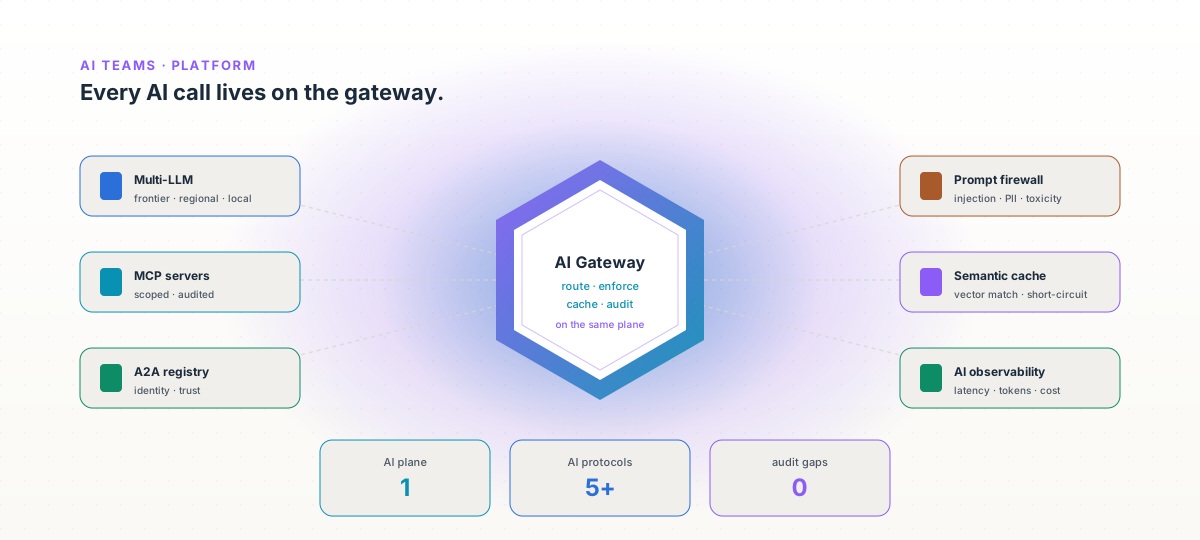
Apinizer's AI Gateway routes prompts, governs MCP servers, registers agent identities, filters bad input, and posts cost to the same audit trail you already use for APIs.
The problem
Teams that skip the gateway get a parallel universe — model keys in env vars, MCP tools wired straight into apps, agents talking without identity, costs invisible until the invoice. Apinizer treats AI as just another lane: same Manager, same Workers, same audit, same identity. The AI plane is a feature, not a side project.
AI plane
AI protocols
LLM · MCP · A2A · embeddings · vision
audit gaps
Capabilities
Route prompts by capability, cost, latency, and sovereignty — frontier when needed, regional when sufficient, open-weight when sovereign.
Every MCP tool registered, scoped, audited. Agents only see the tools you allow; every call lands in the audit ledger.
A2A identity, scope, and trust live on the gateway. Agents authenticate like people; the gateway keeps the trust boundary.
Injection, jailbreak, content safety, DLP, and checksum-validated PII masking at the edge — with encoded payloads decoded before any guard reads them, and an external guardrail engine behind them when a pattern is not enough. Bad prompts blocked; clean prompts logged; the compliance answer is one query.
Semantic cache short-circuits paid calls; per-consumer token attribution turns every prompt into a line item.
One screen lists every AI asset in the installation — proxies, providers, models, knowledge bases, vector databases — and a shadow-AI report names the models being called that nobody put in the catalog. Retention profiles decide how much of an exchange is ever written down, from the full record to nothing at all.
Latency, errors, tokens, anomalies — same Elasticsearch surface as your APIs. Trace any AI call back to a consumer, project, and model.
Use cases
AI assistant inherits the API plane's auth, audit, and rate-limit policy. Regulator stops asking 'where does the model live'.
1 control plane
Connected-car APIs and the assistant share one gateway, one identity, one trace. AI rollout doesn't reopen the platform RFP.
Chatbot is just another endpoint. Authentication, audit, and rate-limit inherited from the citizen API surface — no new compliance memo.
Underwriting model calls go through the same access control as claims data. One dashboard for both; one auditor answer for both.
Multi-LLM routing, semantic caching, MCP governance, observability all arrive in Apinizer. The standalone stack is decommissioned.
1 vendor retired
B2B partners hit the same gateway; their integration agents are published as A2A agents on the gateway. Same SLA, same audit, same identity.
90% of summarization traffic served by an in-region resident model; frontier providers used only for adversarial cases.
90% regional
Local 70B model serves SCADA-adjacent agents. Hosted providers reserved for non-operational use. The agent never crosses the network boundary.
How a call moves
Capability, cost, latency, and policy decide the model — frontier, regional, open-weight, or cache.
Prompt firewall, PII redaction, scope check, and consumer rate limit run before the upstream call.
Semantic match in the vector index short-circuits paid calls when the meaning has been answered before.
Prompt, response, tokens, cost, consumer, project — all indexed in Elasticsearch with the rest of your traffic.
Recommended products
The AI lane — routing, MCP governance, A2A gateway, firewalls, semantic cache.
Open the AI Gateway pageOne identity surface for API consumers, AI consumers, and agent identities.
Open the Identity pagePer-model, per-project, per-consumer telemetry on the same dashboards as your APIs.
Open the Analytics pageProvider health, latency probes, anomaly detection across every AI lane.
Open the Monitoring pageResources
The AI lane on the same Manager, Workers, audit, and identity surface as your APIs.
Multi-LLM routing, MCP governance, A2A gateway, firewalls, cache.
Where the AI lane sits in the topology — control plane, data planes, providers.
Trace any AI call back to a consumer, project, model, and cost.
How per-consumer cost reports turn every prompt into a line item.
The strategy: one platform, every protocol, every audit — AI included.
One AI plane
A 30-minute walkthrough — routing, MCP, A2A, firewalls, cache, observability — on a Kubernetes of your choice.