Rule-based conditional routing
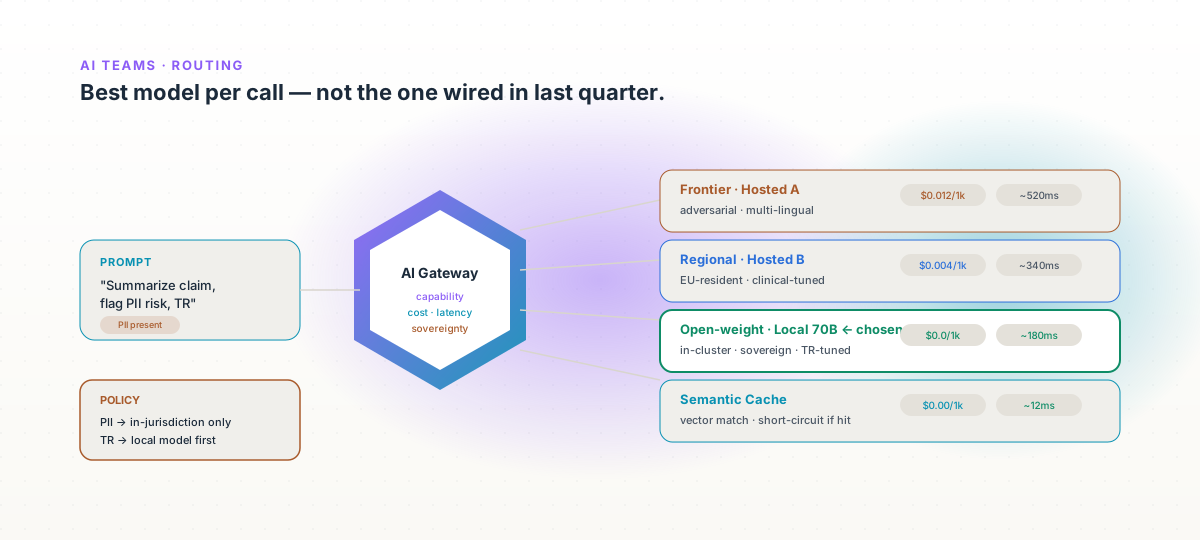
Route on the attributes of the call — consumer, project, headers, requested model class. Summarization to a small model, code generation to a code-specialist, vision to a multi-modal — without changing the application.
AI teams · Routing
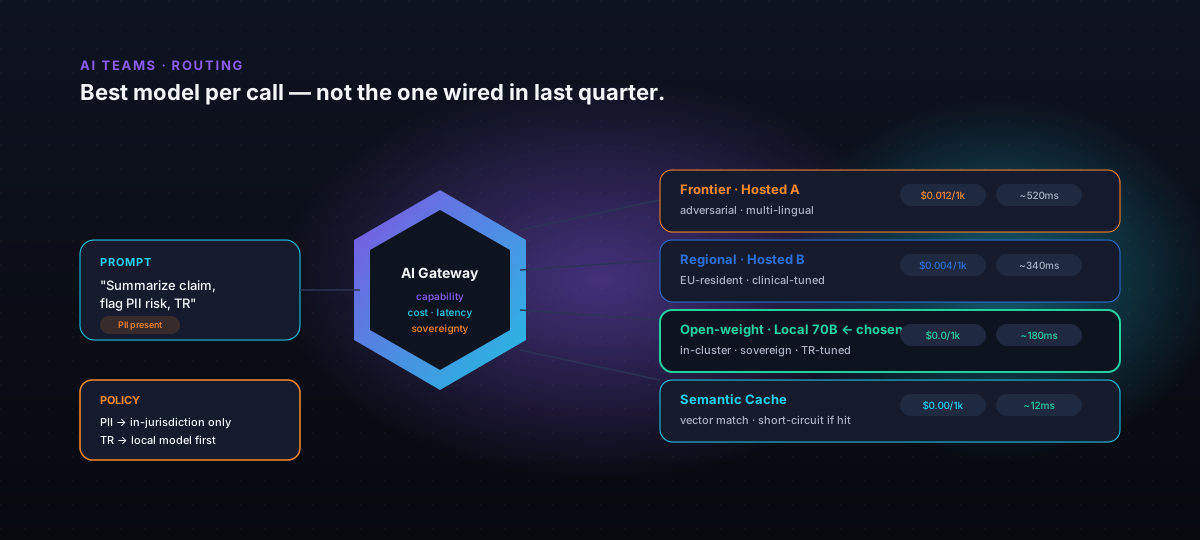
Apinizer's AI Gateway routes every prompt by cost, latency, capability, and policy. Frontier model when needed; regional when sufficient; open-weight when sovereign — all under one identity, one audit, one runtime.
The problem
Services pick a model in a sprint and inherit its bill, its rate limit, its sovereignty profile, and its outages forever. When the provider has an incident, the app does too. When a cheaper model would serve, the team pays the frontier price anyway. Apinizer turns the model into a policy decision — per call, not per service.
Capabilities
Route on the attributes of the call — consumer, project, headers, requested model class. Summarization to a small model, code generation to a code-specialist, vision to a multi-modal — without changing the application.
Two routing algorithms decide for you: least-cost picks off the model catalog's unit pricing, least-latency picks off live health-probe latency. Frontier providers only when the rules say so, and a per-leg cost ceiling on every fall-back. A model past its sunset date is rejected at the gateway and dropped from the OpenAI-compatible `GET /v1/models` discovery response, so a client cannot pin itself to a model that is on its way out.
Twenty-six providers and 185 models ship built in, with pricing and lifecycle dates you edit in the UI. A provider that is not in the catalog — a regional vendor, an internal inference service — is defined on screen rather than through an import file, and the adapter follows the wire protocol it speaks, so a custom endpoint can talk its own native format. Adding one does not wait for a release.
Provider hiccup? Traffic rolls to the next provider in the pool with the same capability profile. Application doesn't know there was an incident.
Conditional routing reads the attributes the request already carries — a header, a token claim, the consumer identity — so traffic carrying regulated data reaches only the providers you approved for that jurisdiction. The rule is data, not code, and once it is deployed it applies to every call automatically.
A fall-back leg on another vendor family gets the request rebuilt in that vendor's native format — OpenAI in, Anthropic or Gemini or Bedrock out. Retries stay idempotent, so a failed leg is never billed twice.
Local llama / mistral / qwen deployments live in the routing pool alongside hosted providers. The application doesn't choose; the policy does.
Use cases
90% of customer-service summaries handled by a TR-tuned model hosted in-country. Frontier providers used only for adversarial or English-mixed cases.
90% local, 10% frontier
Code generation and review go to a code-specialized model; design-doc summarization to a general model. Tail latency drops; quality goes up.
Routing rule reads the request headers and payload. Anything that looks like PII routes only to providers in approved jurisdictions; everything else has the full pool.
Frontier provider returns 5xx for 14 minutes. The gateway rolls to the secondary; application keeps serving without an incident page.
0 user-facing impact
The new model joins the primary pool alongside the incumbent. Per-model cost, latency, and error telemetry in the Analytics Engine settle the question in a week; cutover is one policy change, and rollback is just as easy.
Compliance-approved model list maintained centrally. Routing never picks an uncertified model; auditors stop asking 'which model answered'.
Sovereign Arabic LLM gets first call; frontier providers as fallback. Cost falls; sovereignty story tightens.
Local 70B model runs SCADA agent prompts. Hosted providers reserved for non-operational use. The agent never leaves the operator network.
Recommended products
Rule-based conditional routing, least-cost and least-latency algorithms, sovereignty rules, cross-family failover.
Open the AI Gateway pagePer-model, per-project, per-consumer telemetry to compare options.
Open the Analytics pageCache layer that backs semantic responses, regardless of which model answered.
Open the Cache pageProvider health and latency probes; severity-aware alarms on degradation.
Open the Monitoring pageResources
How conditional rules, cost, latency, and sovereignty compose into routing policy.
The lane every AI call lives on — providers, MCP, agents.
Per-provider, per-project, per-consumer telemetry.
Where the AI lane sits in the topology.
Routing policy ships as code, reviews in Git, applies idempotently.
Where routing composes with MCP governance, A2A gateway, firewalls, and cache.
Explore more
Right model per call
A 30-minute walkthrough — capability routing, cost tiers, sovereignty rules — on a Kubernetes of your choice.