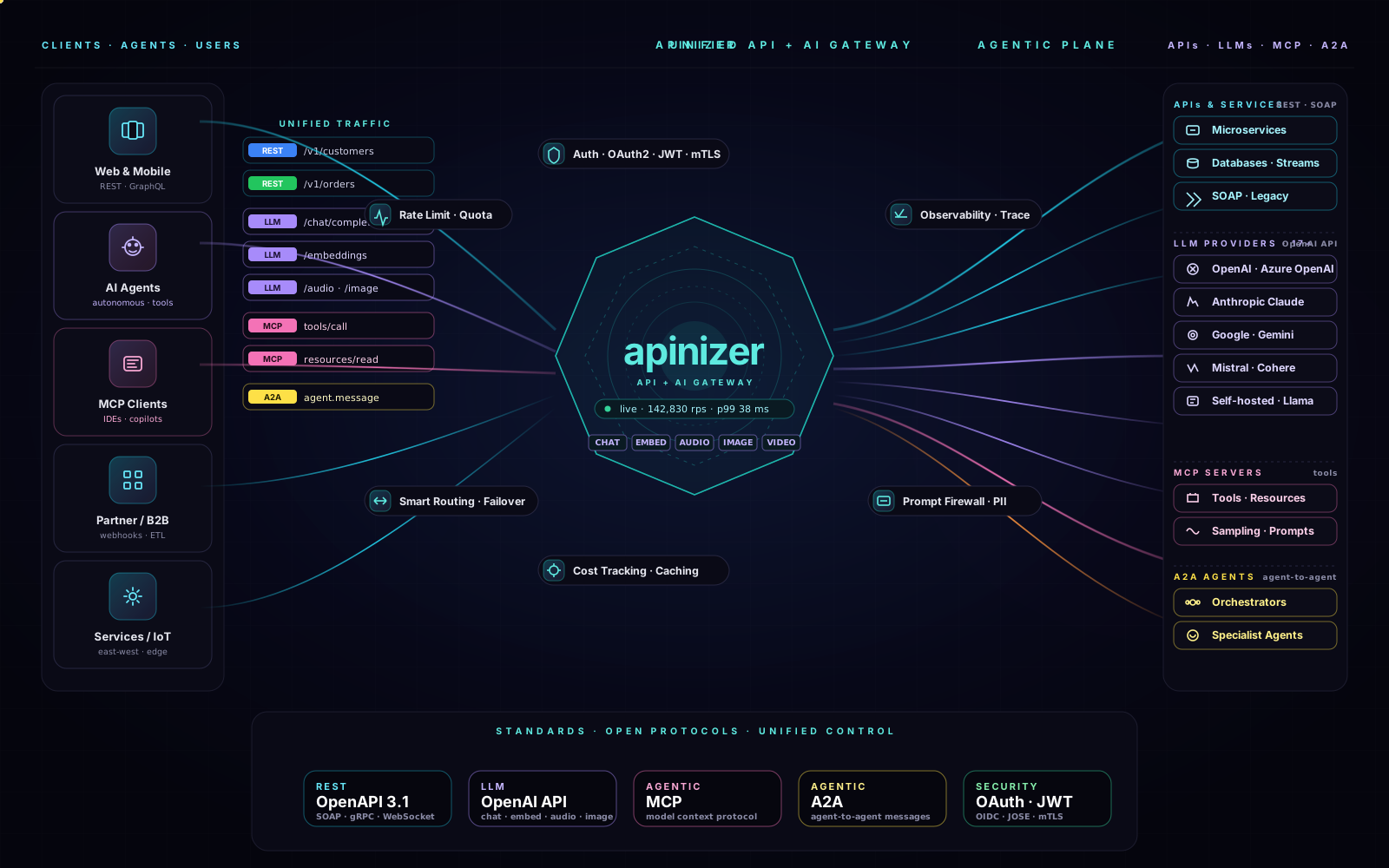
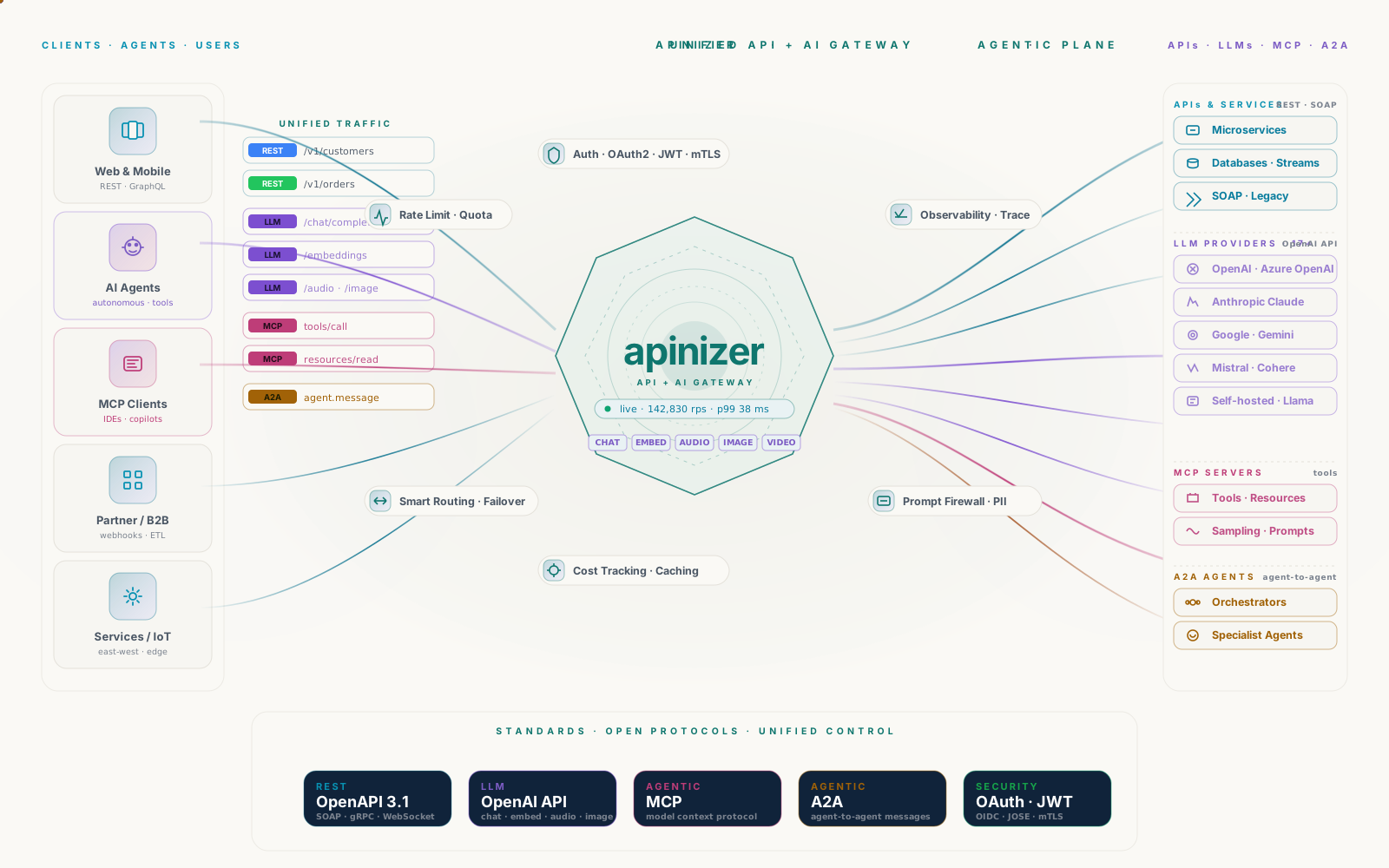
AI Gateway — agentic plane

NEW

Govern every AI request. Tokens, cost, and risk — one gateway.

Track every token. Cap every budget. Route across a 17-provider, 111-model catalog behind one OpenAI-compatible endpoint. Apinizer governs your LLM, MCP, and agent traffic on the same runtime that already runs your REST APIs — same audit, same identity, same operators on call.

  • Catalog17 providers · 111 models
  • StandardsOpenAI · MCP · A2A
  • ModalitiesChat · Embed · Audio · Image

Token economics and cost control — first-class

Every prompt, every response, every embedding — counted, attributed, and capped. Set token and USD budgets on the gateway scope chain — global, anonymous, credential, credential-org, proxy, and tenant — plus per-model and per-provider ceilings, in any time window. The same three-tier permission model (System / Project / Team) that owns REST access owns who may edit those budgets, so the people who own the workload also own the bill.

  • Live token tracking — input, output, cached, and total — per request
  • Limits in tokens or in dollars, per minute, hour, day, or month (TPM + USD; request-per-minute is the platform throttle policy)
  • Six scope tiers — global → anonymous → credential → org → proxy → tenant — crossed with provider and model
  • Hard caps plus threshold alarms at 50%, 80%, 90%, and 100% of budget
  • Cost attribution back to a project or cost center — finance gets a line item, not a mystery
  • Auto fall-back to a cheaper model or a cached answer when the budget tips
  • Per-model unit pricing you edit in the UI, with cached tokens billed separately
Tracked per request
input · output · cached · total tokens
Quota windows
minute · hour · day · month
Quota scopes
global · anonymous · credential · org · proxy · tenant × provider · model
Measured in
tokens or USD
Enforcement
hard cap · threshold alarm · graceful fallback
Reporting
cost by project · model · team · time range

Cost-aware multi-LLM routing

Write the application once against an OpenAI-compatible endpoint. The gateway decides which model actually answers — cheapest, fastest, load-balanced, or whatever your routing rules say. Drop in a cheaper model for summarisation, send tier-one customers to the frontier model, fall back to a self-hosted model when a provider degrades. Requests are translated into each provider's native format on the way out, so a fall-back chain can cross vendor families mid-flight.

  • OpenAI-compatible request and response shape — no client rewrites, drop-in for the openai and langchain_openai SDKs
  • Seven routing algorithms — primary/fall-back chain, load-balanced pool, rule-based conditional, least-cost, least-latency, prefix affinity, and cheaper-model downgrade on budget overflow
  • Two-way OpenAI ↔ native translation — Anthropic, Gemini, Vertex, and Bedrock bodies rebuilt per leg, including cross-family failover
  • Provider fall-back chains with idempotent billing — a retried request is never counted twice, and a leg over its cost ceiling is skipped
  • Real per-chunk SSE streaming with backpressure and disconnect handling, trailing usage collected on stream end
  • Unary agentic tool-call loops with a turn ceiling and per-turn metering (streaming agentic loops are on the roadmap)
  • Native adaptersOpenAI · Anthropic · Gemini / Vertex · Bedrock · vLLM
  • Catalog17 providers · 111 models · UI-editable pricing
  • OpenAI-compatibleany provider or self-hosted model on the OpenAI wire format
  • Outbound authBedrock SigV4 · Vertex OAuth2 · bearer keys
  • Endpointschat/completions · responses · embeddings · audio · images

Exact and semantic response cache

Skip the token bill on repeat prompts. Apinizer answers an identical prompt from the Hazelcast cluster the REST gateway already runs, and a re-worded prompt from a real vector layer — embeddings scored against your own VectorDB above a similarity threshold you set. The cache stores the masked form of a response, so a cache hit can never replay data the PII policy stripped on the way out.

  • Exact-match keying by SHA-256 over the request, cluster-wide on Hazelcast
  • True vector layer — embedding similarity over pgvector, Qdrant, or Redis with your own threshold and top-K
  • Tune what gets keyed — last N messages, system / assistant / tool roles in or out, and `Cache-Control: no-store` and `no-cache` honoured
  • Masked-first caching — the semantic layer never stores the raw pre-mask body
  • Configurable TTL and size ceiling, proxy-scoped so two AI proxies never share a bucket
  • Atomic invalidation on redeploy, plus a TTL purge job for expired traces
  • Live hit-rate plus estimated token-spend saved (average miss cost × hits) and latency-saved reports per cache bucket
Exact match
SHA-256 request key on Hazelcast
Semantic match
embedding similarity · threshold + top-K
Vector stores
pgvector · Qdrant · Redis (RediSearch KNN)
Key tuning
message countback · role filters · cache-control
Safety
masked body cached · proxy-scoped isolation
Reports
hit rate · tokens saved · latency saved

Prompt templates and decorators on the gateway

The client sends a template name and a few parameters; the gateway assembles the real prompt. Templates live in a catalog scoped built-in, platform-wide, or per project, and decorators prepend the system blocks every team keeps forgetting — privacy, bias, security, scope. Application code stops carrying the prompt, and a prompt change ships through APIops instead of a release.

  • Template catalog with `{{param}}` placeholders, required flags, and defaults — three scopes: built-in, platform, project
  • Gateway-side expansion — single-pass substitution, closed to template and JSON-structural injection, with fail-closed size ceilings
  • Prompt decorators — prepend or append system blocks per role, merge into an existing system message, with `${env}` values resolved at runtime
  • Nine built-in responsible-AI presets: bias & fairness, explainability, privacy, content moderation, ethical AI, security, regulatory compliance, short responses, technology concealment
  • Enforced assembly order — template, then decorator, then RAG, then guards and cache — regardless of how the policies were arranged
  • Templates are exportable artifacts: wizard, REST, or APIops promotion from dev to test to prod
json
// The client sends this…{ "model": "gpt-4o-mini",  "template": "support-summary",  "template_params": { "tone": "formal", "ticket": "INC-4417" } }// …the gateway expands the catalog template, prepends the// privacy + regulatory-compliance decorators, injects RAG// context, then runs the guards and the cache — in that order.

RAG on your own VectorDB — nothing leaves the cluster

Ground answers in your documents without shipping them anywhere. Upload to a knowledge base, and Apinizer chunks, embeds, and indexes into a VectorDB you run. At request time the gateway retrieves and injects context before the guards and the cache see it — and the retrieval is bounded by project and knowledge base, so one tenant's question can never reach another tenant's chunks.

  • Knowledge bases with document upload, PDF text extraction, chunking, and embedding indexing
  • Four injection modes — prepend to the user turn, prepend or suffix the system message, or a template
  • Top-K and similarity threshold per policy, with an explicit behaviour when nothing matches
  • Multi-tenant isolation enforced at query time — project and knowledge-base filters on every retrieval
  • Fail-closed by default: when the project scope cannot be resolved, injection is skipped rather than widened
  • GDPR / KVKK erasure on indexed documents — delete the source, drop the vectors
  • pgvector, Qdrant, or Redis as the runtime store, with pooled connections and atomic redeploy
Sources
document upload · PDF extraction · chunk + embed
Stores
pgvector · Qdrant · Redis (RediSearch KNN)
Injection
prepend user · prepend system · system suffix · template
Tuning
top-K · similarity threshold · no-match behaviour
Isolation
project + knowledge-base filter, fail-closed
Order
retrieve → inject → guards → cache

Prompt firewall — injection, jailbreak, topic, and data loss

Block the patterns that put regulated AI projects on hold: prompt injection, jailbreak chains, conversation-structure tampering, credential exfiltration, off-topic prompts that burn budget, and runaway loops. The guards run inline — the bad request never reaches the model — and you can put a second-opinion model behind them when a regex is not enough.

  • Prompt guard — injection and jailbreak detection with preset pattern libraries, in inline, async, or shadow mode
  • Topic guard — embedding-similarity allow-lists and deny-lists with separate thresholds; deny wins, and it fails closed
  • Context-integrity guard — control tokens and forged role sequences caught before the model sees a tampered conversation
  • DLP guard — secret and credential presets, sticky block across both directions of the exchange
  • Oversize and loop guards — body ceilings and repeat-request patterns, so one client cannot drain a budget
  • External guardrail providers through one adapter — an LLM-as-judge endpoint, or any OpenAI-compatible judge (vLLM, Ollama)
  • Configurable AI and MCP error responses — your wording, your status codes, on every guard decision
Inline guards
injection · jailbreak · context integrity
Topic guard
allowed + denied topics · deny-first · fail-closed
Data guards
DLP presets · credentials · secrets
Budget guards
oversize body · loop detection
External engines
LLM-judge · OpenAI-compatible (vLLM · Ollama)
Latency modes
inline · async · shadow

PII masking that survives streaming

Turkish identity data is a first-class citizen, not a custom regex you maintain. TCKN, IBAN, and Turkish phone numbers are validated by checksum before anything is masked, so the gateway redacts real identifiers instead of any eleven digits it happens to see. Masking runs on a sliding window across SSE chunks — an identifier split across two chunks is still caught — and on MCP and A2A tool results through the same policy.

  • Twelve built-in types — TCKN, IBAN, Turkish phone, email, credit card, IP, URL, passport, US SSN, TR driver's licence, generic bank account, crypto wallet
  • Checksum validation wherever the format defines one — mod-97, Luhn, base58check, bech32, EIP-55
  • Six mask modes — fixed, keep-first, keep-last, mask-first, placeholder sequence, or synthetic-but-valid replacement — plus delete, encrypt, hash, and detect-only operations
  • Placeholder sequence keeps references consistent inside a request, so the model can still reason about "the same customer"
  • Chunk-boundary-safe masking on streaming responses, including the terminal events of the Responses API
  • Custom regex and element-name rules, plus a three-scope Turkish PII preset catalog
  • The same masking applied to MCP and A2A tool results — the tool output is not a side door
Turkish types
TCKN · IBAN-TR · phone-TR · driver's licence
International
email · card · IP · URL · passport · SSN · IBAN · wallet
Validation
checksum-verified before masking
Mask modes
fixed · keep-first · keep-last · mask-first · placeholder · synthetic
Streaming
sliding window across SSE chunks
Also covers
MCP and A2A tool results

AI observability — every prompt, every token, every model

The Analytics Engine ingests AI traffic next to REST traffic — 28 sparse AI fields on every log record. One query answers cost-by-team, latency-by-provider, error-rate-by-model, and which guard tripped last night. When you already run Grafana, the gateway exports native OTLP with GenAI semantic conventions and a Prometheus metric family, so AI traffic lands in the dashboards your SRE team already watches.

  • Token spend by user, project, team, provider, model, and time window — eight report breakdowns
  • Time-to-first-token and time-per-output-token per provider and per model, not just total latency
  • Live trace with a request DAG — a chained agent call is one tree, not five unrelated log lines
  • Timeline viewer and replay — re-run a captured request on the worker to reproduce what happened
  • Guardrail Hits and Cache Efficiency reports, plus a cost breakdown finance can read
  • Native OTLP export (HTTP and gRPC) with OpenTelemetry GenAI semantics, a Prometheus metric family, and a Grafana dashboard you can import
  • AI alerts and anomaly detection on spend and latency — the bill never surprises you twice
  • Cost dashboardstokens · dollars · by project, team, model
  • Latency dashboardsTTFT · TPOT · p50 · p99 · by provider
  • Tracinglive trace · request DAG · timeline · replay
  • Securityguardrail hits · masking counts · injection attempts
  • ExportOTLP GenAI semconv · Prometheus · Grafana dashboard
  • Anomaliesspend spikes · latency spikes · cache miss surges

MCP and A2A as first-class proxies

MCP and Agent2Agent are not a bolt-on server next to the gateway — they are proxy types alongside REST, SOAP, and AI, with the same policy chain, the same deploy history, the same rollback. When you open an MCP or A2A endpoint you pick one of two modes: expose the REST and SOAP APIs you already publish as tools, or pass through to an external MCP server or agent. Either way the agent authenticates through the same policies as every other client, and every call lands in the same audit record.

  • Two MCP modes — turn the REST and SOAP APIs you already publish into MCP tools, or pass through to external MCP servers with credential exchange and an allow-list
  • Two A2A modes — publish a proxy as an agent with a discoverable agent card, or front an external agent and rewrite its card
  • Standard policy chain for auth — JWT, OIDC, OAuth 2.0, API key, mTLS — no separate agent auth scheme to maintain
  • Default-deny identity ACL with tool slicing: which credential, role, or org may call which tool
  • Tool-catalog drift detection — the tool schema is pinned by hash, and a health job flags a silent change
  • Argument constraints per tool — regex, max length, enum, required — evaluated with a ReDoS deadline
  • Per-tool call quotas, and client-token passthrough off everywhere until you explicitly opt in
  • Aggregate up to ten backend MCP servers behind one path with deterministic namespacing and fail-soft discovery
  • A2A task lifecycle with streaming relay, resubscribe, push notification, and a cancel that actually interrupts the worker
MCP modes
expose REST / SOAP APIs as tools · passthrough
A2A modes
agent-expose · passthrough
MCP versions
2024-11-05 · 2025-03-26 · 2025-06-18 (default) · 2025-11-25 · 2026-07-28
Access
default-deny ACL · per-tool RBAC · output filter
Governance
schema drift pin · argument constraints · call quota
Outbound
mTLS fail-closed · OAuth 2.0 · SSRF-guarded probes

One gateway, one audit, one runtime

AI Gateway is not a side-car. It is a layer of policies on the same gateway that runs your REST, gRPC, WebSocket, SOAP, and GraphQL traffic. Same identity, same audit, same observability, same operators. There is no second control plane to learn, no second pager rotation, no second invoice.

  • Same gateway runtime — REST, gRPC, WebSocket, SOAP, GraphQL, MCP, A2A, and AI on one process
  • Same identity surface — OAuth 2.0, OIDC, JWT, mTLS, SAML for humans, agents, and partners
  • Provider API keys stay on the LLM connection — applications authenticate with their own credentials, never with the upstream key
  • LDAP identity sync for AI consumers — paged fetch, scheduled jobs, sync history
  • Same audit at the persistence layer — bypass rejected at compile time
  • Same three-tier permission model — System, Project, Team — plus dedicated AI roles for development, budgets, and analytics
  • Same explicit deploy path — save, review, deploy, roll back; prompts and routes change without restarting a pod
  • Same Kubernetes posture — self-hosted, air-gap friendly, no data leaves the cluster
  • Runtimeone gateway process · API + AI
  • Identityhumans · agents · partners on one surface
  • Auditpersistence-layer, immutable, replayable
  • RBACSystem / Project / Team — everywhere
  • Deployhot — prompts, routes, models
  • PostureKubernetes-native · air-gap friendly

Use cases

Where teams put it to work.

Stop the AI bill from running away

Token budgets per project. Response cache on the hot path. Cheap-model fall-back when the budget tips. Cost attribution by team and project. The AI line item stops being a surprise, and finance gets a cost report instead of a Slack message.

  • Token and USD ceilings on credential, organization, proxy, and project scopes
  • Exact and semantic response cache with hit-rate and savings reports
  • Cheaper-model downgrade and least-cost routing off the catalog price
  • Cost attribution back to the project that ran the workload
  • Monthly cost exports for finance

In the box

What's included

The capabilities below are part of the standard install — no add-on SKUs and no separate licenses.

AI traffic types

  • Chat completions — unary and streaming
  • Responses API — unary and streaming
  • Embeddings — client-facing, shared with RAG and semantic cache
  • Audio — speech-to-text and text-to-speech
  • Image — generation
  • Function calling, tool use, and unary agentic loops
  • Agent-to-Agent (A2A) messages and tasks
  • Model Context Protocol (MCP) tool calls

Cost & token governance

  • Live token tracking — input, output, cached, total
  • Ceilings per window — minute, hour, day, month
  • Ceilings per owner tier — credential, organization, proxy, project
  • Ceilings per provider and per model, measured in tokens or dollars
  • Threshold alarms at 50 / 80 / 90 / 100 percent, with monthly reset
  • Auto fall-back to cached answer or cheaper model on budget tip
  • Cost exports back to the project that ran the workload

Security & guardrails

  • Prompt injection, jailbreak, and context-integrity guards
  • Topic guard with allow-lists and deny-lists on embedding similarity
  • Twelve built-in PII types with checksum validation, including TCKN and IBAN-TR
  • Six masking strategies, from redaction to synthetic-but-valid values
  • Masking that holds across streaming chunks and on tool results
  • DLP, oversize, and loop guards
  • External guardrail engines through one adapter (LLM-judge)
  • Default-deny tool RBAC per identity
  • Audit trail at the persistence layer

RAG & knowledge

  • Knowledge bases with upload, PDF extraction, chunking, and indexing
  • pgvector, Qdrant, or Redis as the vector store — self-hosted
  • Four RAG injection modes with top-K and similarity threshold
  • Project and knowledge-base isolation enforced at query time
  • Fail-closed when the project scope cannot be resolved
  • GDPR / KVKK erasure on indexed documents

Operability

  • Same gateway runtime as REST, SOAP, gRPC, WebSocket, MCP, and A2A
  • Same identity, same audit, same RBAC across API and AI
  • Explicit deploy with history and rollback; no pod restart for a prompt change
  • Three-tier permission model (System / Project / Team) plus dedicated AI roles
  • Live cost, latency, and reliability dashboards
  • OTLP, Prometheus, and Grafana export for existing SRE tooling
  • Kubernetes-native, air-gap-friendly deployment

Govern every AI request

Bring tokens, agents, and risk under one control plane.

A 30-minute walkthrough of the Apinizer AI Gateway — token budgets, multi-LLM routing, exact and semantic cache, prompt firewall, PII masking, RAG on your own VectorDB, MCP and A2A governance, and AI observability — on a Kubernetes of your choice.