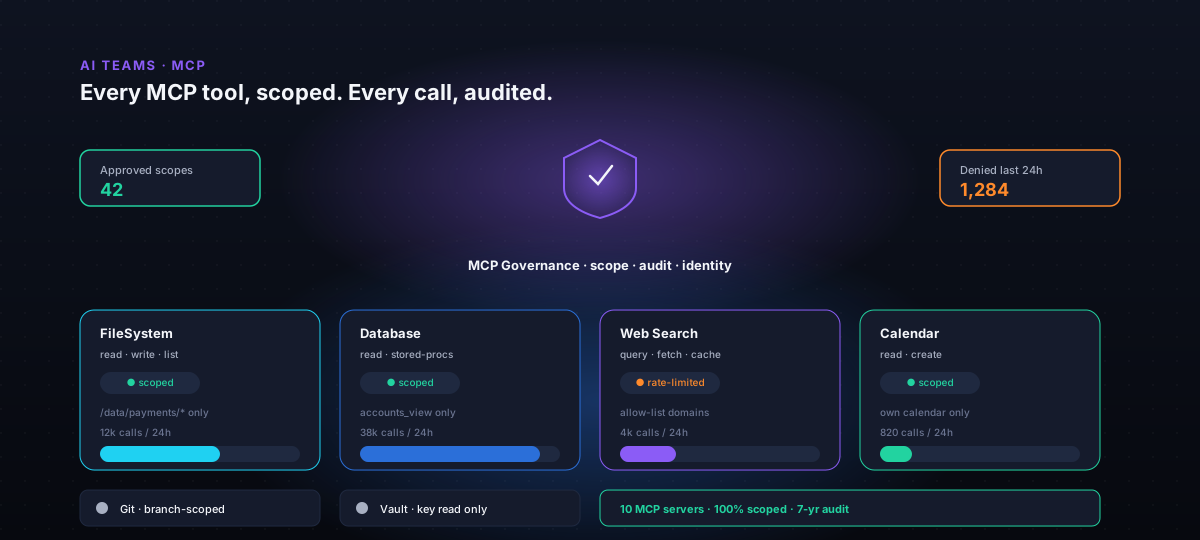
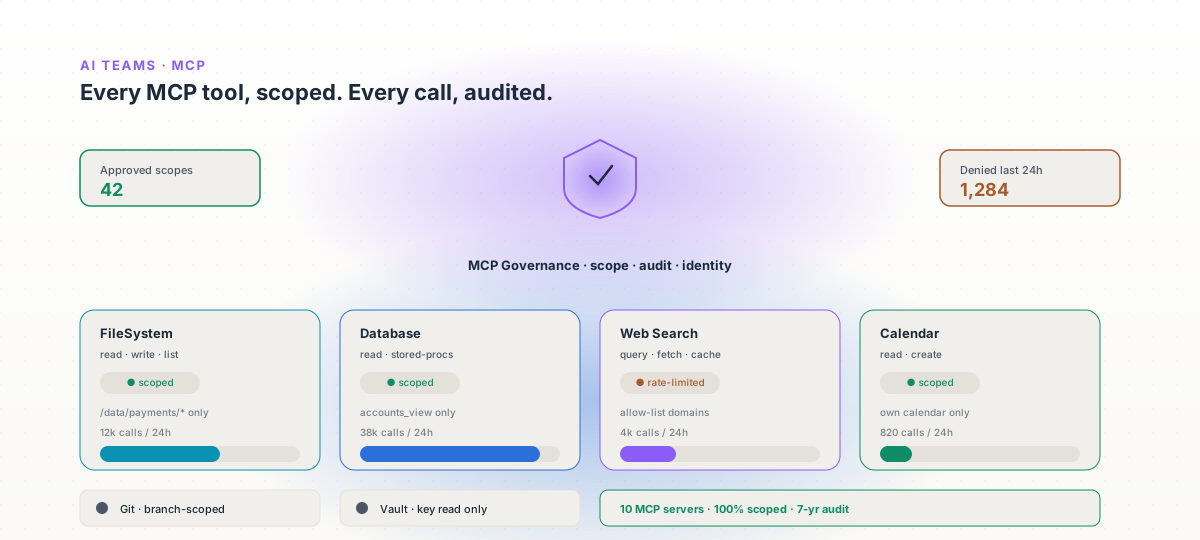
Every MCP server registered. Every call authorized. Every action audited.
Apinizer's AI Gateway treats the Model Context Protocol surface as a first-class plane. Agents discover only the servers they're scoped to; every invocation passes the same auth and audit as any other API call.
Agents reach for MCP servers the way services used to reach for internal APIs in 2014 — without auth, without scope, without an audit log. The moment an agent can call 'send email' or 'create ticket', the org needs the same governance the API plane took a decade to build. Apinizer's MCP governance applies that decade of work to the new plane on day one.
Capabilities
What Apinizer does here
MCP is a proxy type, not a side-car
Opening an MCP endpoint is a two-way choice: publish the REST and SOAP APIs you already run as MCP tools, or pass through to an external MCP server — with an allow-list, an output filter, and up to eleven backends aggregated behind one path with deterministic namespacing.
Authenticated invocations
Every MCP call runs the standard policy chain — OAuth 2.0, OIDC, JWT, API key, mTLS — the same one your REST proxies use. Only manifest discovery is exempt. No anonymous tool access, and no second auth scheme to maintain.
Default-deny tool access
An agent might call read_calendar but not write_calendar. The access list starts closed and is sliced per tool, per credential, per role, per org — reviewed in the same UI as API permissions.
Audit at the tool boundary
Every MCP invocation captured at the framework boundary. Who, what, when, which tool, which arguments — immutable, queryable, exportable.
Tool calls visible without trace
Which tools a flow called on the way out — and how many times — are written onto the ordinary traffic record, not buried in a trace you have to switch on first. "What did this agent actually do" becomes a query over the same log the rest of the estate already writes.
Quotas, argument limits, drift detection
Call quotas per tool, plus regex, max-length, enum, and required constraints on the arguments an agent may pass. Each tool's schema is pinned by hash and re-checked by a health job — when an upstream server quietly changes what a tool does, you get a warning or a closed door, your choice.
Credentials exchanged, not forwarded
The gateway exchanges its own credentials with the backend MCP server, held encrypted at rest and never logged. Forwarding the client's token is off everywhere until you explicitly opt in, per target.
Use cases
In production, this looks like…
Banking
Istanbul bank governs 14 MCP servers across the SOC and ops teams
Each server registered with owner, scope, and auth requirement. Agents see only the tools they're scoped to; the SOC sees every invocation.
Manufacturing
Munich OEM exposes MES tools to factory agents via MCP
MES servers registered with per-line scopes. Line 3 agents cannot read line 4 telemetry; auditors confirm in one query.
Insurance
Paris insurer enforces PII boundaries on MCP-exposed claim tools
Tools that touch PII require a stricter identity claim. The gateway rejects under-scoped invocations; agents fall back to redacted variants.
Government
Riyadh ministry rate-limits 'create ticket' to prevent agent storms
Per-agent throttle on ticket creation. A misbehaving prompt loop can't flood ITSM; severity-aware alarm catches the loop in 90 seconds.
Telecom
Madrid carrier audits every MCP call across 230 agent flows
Audit query returns 'who used tool X in window Y' in seconds. The MCP plane has the same forensic surface as the API plane.
Media
Milan publisher binds MCP credentials to short-lived JWTs
Agents never hold long-lived secrets. Each invocation carries a per-call token; rotation is automatic.
Energy
Prague utility separates MCP planes for ops and finance agents
Operations agents discover only operations servers. Finance agents discover only finance servers. Same Manager; different scopes.
Public sector
Baku ministry adds an MCP server to the existing API portal
The portal lists MCP servers alongside REST APIs. Partners request access to either via the same flow.