Agent identities
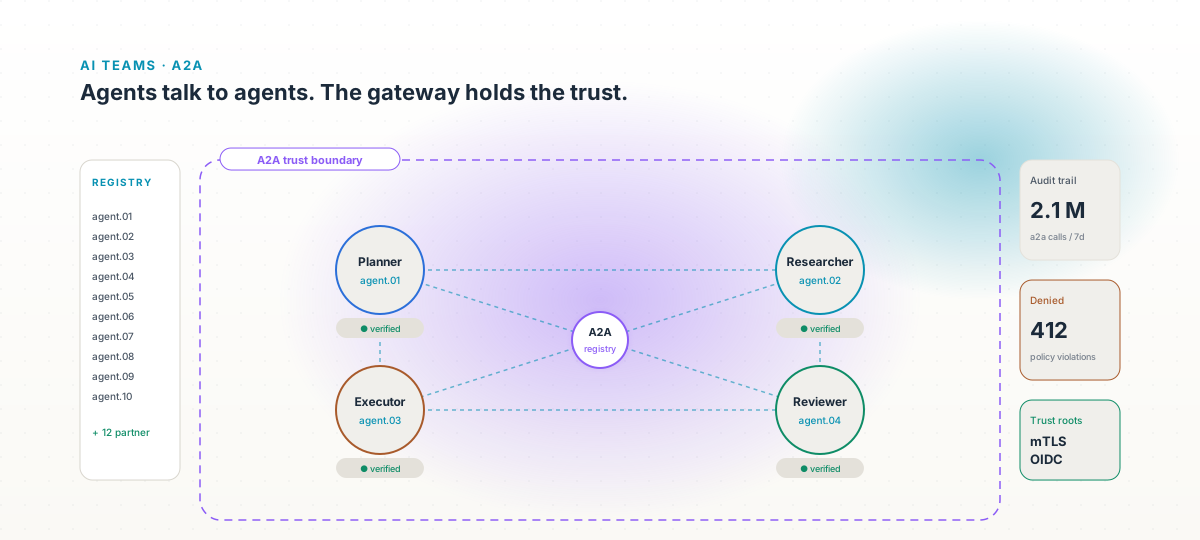
Every agent authenticates with a Credential — same identity plane as API consumers. OIDC / JWT policies apply; revoke the credential and the next call is denied.
AI teams · A2A
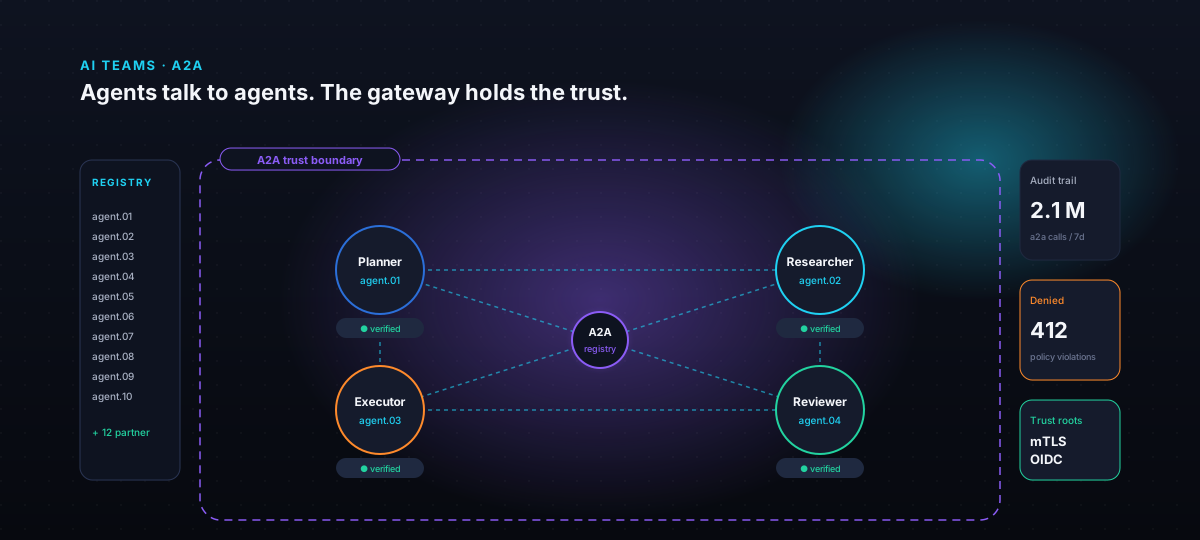
Apinizer's A2A gateway gives every agent an identity, a discoverable capability card, and a scoped permission set. Conversations flow through the gateway with the same auth and audit as any other request.
The problem
An ops agent calls a security agent. A research agent calls a planning agent. None of them have a real identity; none of the calls have an audit trail. The first time a regulator asks 'which agent did this', the org has nothing. Apinizer treats A2A as a first-class plane: identities, scopes, contracts, and a single audit ledger.
Capabilities
Every agent authenticates with a Credential — same identity plane as API consumers. OIDC / JWT policies apply; revoke the credential and the next call is denied.
Publish a proxy as an agent and it serves a standard agent card at the well-known path. Front someone else's agent and the gateway rewrites the card — your hostname, your security schemes, only the skills you chose to expose.
Send a message, poll a task, cancel a task — with streaming relay, resubscribe after a dropped connection, and push notification. A cancel actually interrupts the work on the worker; it is not a status flag.
Which agents a flow reached and which skills it invoked are written onto the ordinary traffic record, alongside a call count — no trace to switch on first. Fronting an external agent behaves the same way: task status and cancellation are relayed to the agent that owns the task, so a client can follow a task it started through a passthrough proxy.
Every message between agents captured with both sides' identities and the result. Chained calls form one trace tree, and a captured request can be replayed to reconstruct exactly what happened.
An agent that's allowed to call 'search' can't call 'modify'. Permission applied at the runtime; nothing depends on prompt obedience.
A2A lives on the same gateway as API and MCP traffic. One identity surface, one audit ledger, one set of policies.
Use cases
Each agent has an owner, a capability profile, and a permission set. Cross-team calls go through the A2A surface, not direct webhooks.
Planner agent discovers each plant's local agent via the registry; A2A messaging carries contracts. Plant operators see the entire chain in audit.
Scope enforced at the gateway. The agent can answer 'what's my balance' through a billing peer but cannot trigger a refund — different scope, different agent.
Triage agent → underwriting agent → fraud agent. The audit query joins all three legs into one timeline; the DPO traces a complaint in minutes.
Partner agents authenticate with JWTs. Their agent cards are published through the gateway; partners never see internal agents they don't have access to.
Agent credential revoked; all conversations drop on next call. No need to chase webhooks across services.
Two ministries, one citizen-services chain, one audit trail. Each ministry's agent stays in scope; cross-ministry calls go through the A2A surface explicitly.
Ops agents can call analytics agents; analytics cannot call ops. The boundary is enforced by the gateway, not by hopeful design.
Recommended products
A2A proxy modes, identity issuance, task lifecycle, conversation audit.
Open the AI Gateway pageAgent identities issued and revoked alongside human identities.
Open the Identity pageEnd-to-end conversation timelines across agent chains.
Open the Analytics pageSeverity-aware alarms when an agent chain drifts or stalls.
Open the Monitoring pageResources
Identity, discovery, scopes, contracts — the building blocks of governed agent-to-agent traffic.
Where A2A traffic lives — alongside LLM, MCP, and API calls.
Issuing and revoking agent identities the same way you handle users.
Conversation telemetry — who called whom, with what contract, at what cost.
When agents call tools, not just other agents.
Where the A2A plane sits in the topology.
A2A, governed
A 30-minute walkthrough — registry, identity, contracts, audit — on a Kubernetes of your choice.