100+
Regulated organizations
Banks · ministries · defense · telecom
Why Apinizer
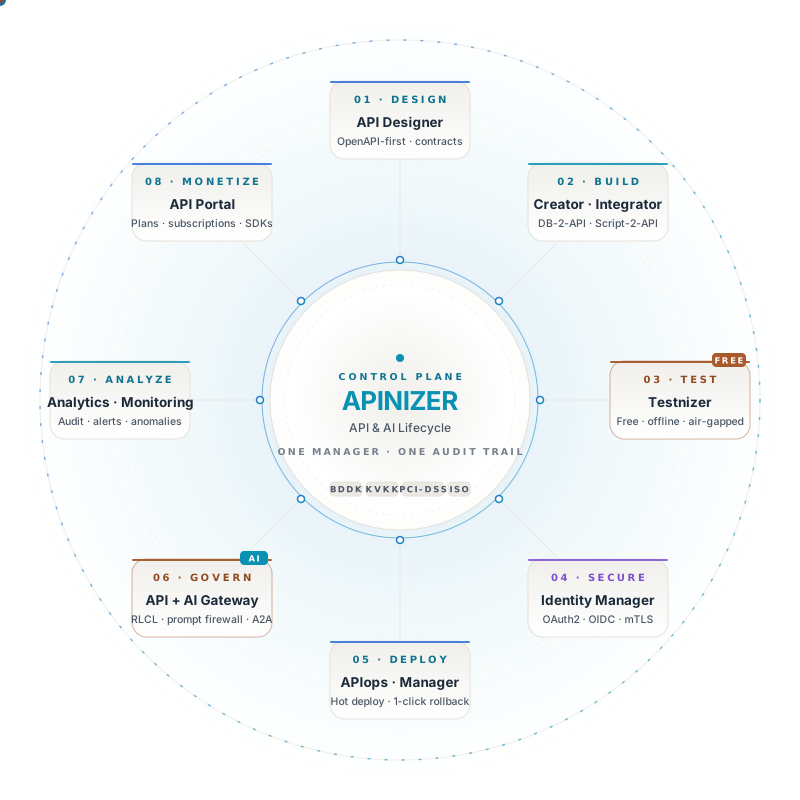
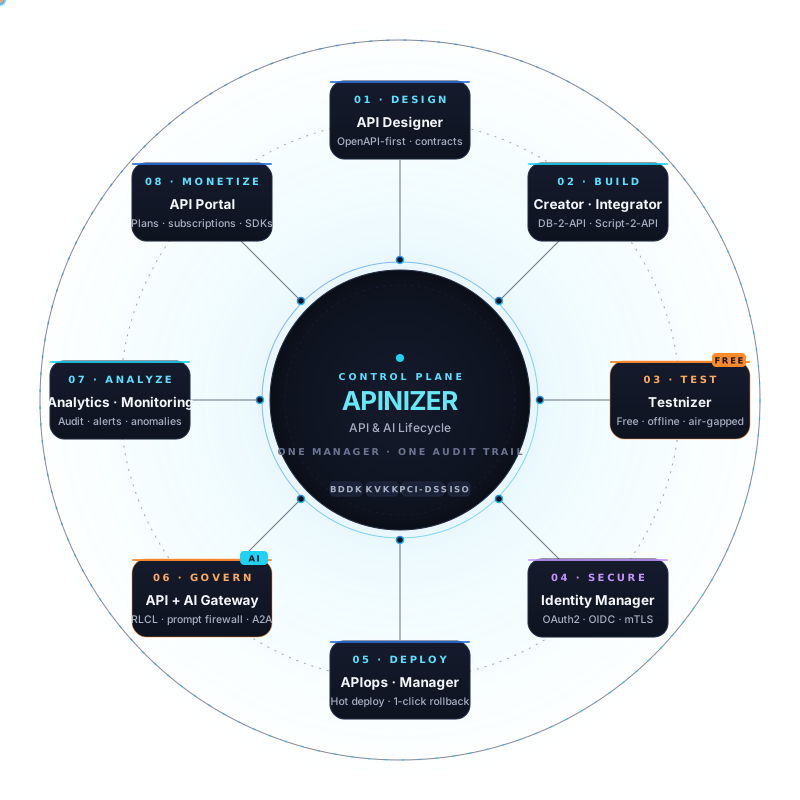
Apinizer is the unified API & AI Gateway platform for banks, ministries, defense, telecom, and the operators next to them. One Manager. One Worker. Ten modules under one license. On the Kubernetes — or OpenShift, Tanzu, or VMs — you already run.
Regulated organizations
Banks · ministries · defense · telecom
TCO advantage
Indicative model vs IBM DataPower / Layer7
RPS per node
1–3 ms median latency
Modules · one license
Gateway · Identity · Portal · AI Gateway · …
Trusted by 100+ organizations across banking, government, and defense
What sets us apart
Most API gateways are pieces of a platform — packaged, priced, and operated separately. Apinizer is the platform itself: every surface governed by the same audit trail, the same identity, the same permissions — on the cluster you already run.
Gateway, Identity, Portal, Analytics, Cache, Monitoring, API Creator, Designer, Integrator — under one license. Most competitors sell each module separately and stitch them with their own glue.
REST, SOAP/XML, gRPC, WebSocket, GraphQL, SSE, MQTT — and now LLM, MCP, agent-to-agent. Mediation, transformation, and policy stay identical across surfaces. No second runtime to operate.
Audit trail, RBAC, three-tier permissions, encryption, KVKK / GDPR / BDDK / PCI-DSS / ISO 27001 controls are baked into the framework. Bypassing them is rejected at compile time, not by convention.
Runs on your Kubernetes, your OpenShift, your Tanzu, or your VMs. Air-gapped supported, not bolted on. The Worker phones nothing home; the Manager carries no hidden cloud dependency.
Visual designer for routes, policies, mediation, and lifecycle. Groovy / JS / JOLT / XSLT for the moments you need code. Most teams ship in days, not quarters — without hiring Lua, NGINX, or proprietary-policy specialists.
Banks, ministries, defense agencies, and the operators that work next to them — that's where Apinizer was sharpened. The defaults reflect what auditors and supervisors actually demand on review day.
One Manager · One Worker · One license · One audit trail
How we compare
Each alternative has its place. Below is what we actually hear when customers move to Apinizer — including the migration window and five-year cost delta from the last 24 months of replacements.
Replacing
IBM
Where they fit — Strong XSLT / WS-* legacy and IBM ecosystem (MQ, CICS, IMS) — at appliance prices.
Where Apinizer wins
Replacing
Broadcom
Where they fit — XML-heavy estates with deep Layer7 expertise already in the building.
Where Apinizer wins
Replacing
OSS / Lua
Where they fit — Cloud-native microservice estates with strong DevOps + Lua expertise.
Where Apinizer wins
Replacing
Modular OSS
Where they fit — Greenfield projects with engineering-led API ownership and small estates.
Where Apinizer wins
Feature matrix
Hover any row to read the detail. Partial means “available via paid module, external plugin, or community workaround” — not the same as included.
| Capability | Apinizer | Kong OSS / Enterprise | Layer7 Broadcom | DataPower IBM | Tyk OSS / Enterprise |
|---|---|---|---|---|---|
All-in-one platform (Gateway · Portal · Identity · Analytics) One license — no separate Dashboard / Portal / Cockpit modules | Supported | Partial / paid module / external | Partial / paid module / external | Partial / paid module / external | Partial / paid module / external |
Kubernetes-native (Helm · Operators · HPA) | Supported | Supported | Not supported | Partial / paid module / external | Supported |
OpenShift · Tanzu · plain-VM workers — same artefacts Hybrid topology under one Manager | Supported | Partial / paid module / external | Partial / paid module / external | Partial / paid module / external | Not supported |
Air-gapped deployment supported, not bolted on | Supported | Partial / paid module / external | Partial / paid module / external | Supported | Partial / paid module / external |
Native gRPC + transcoding (gRPC ↔ REST) | Supported | Supported | Not supported | Partial / paid module / external | Supported |
GraphQL Gateway (federation · field-level caching) | Supported | Partial / paid module / external | Not supported | Not supported | Partial / paid module / external |
WebSocket · Server-Sent Events · MQTT | Supported | Supported | Not supported | Partial / paid module / external | Supported |
SOAP · JMS · DB-2-API legacy mediation JOLT · XSLT · Groovy · visual designer | Supported | Not supported | Supported | Supported | Not supported |
AI Gateway — multi-LLM · MCP · Agent-to-Agent Token quotas · prompt firewall · semantic cache · RAG | Supported | Partial / paid module / external | Not supported | Not supported | Not supported |
Three-tier RBAC + multi-tenant project isolation | Supported | Partial / paid module / external | Partial / paid module / external | Partial / paid module / external | Partial / paid module / external |
Audit trail · immutable change history (default) | Supported | Partial / paid module / external | Supported | Supported | Partial / paid module / external |
BDDK · KVKK · PCI-DSS · ISO 27001 controls shipped | Supported | Not supported | Partial / paid module / external | Partial / paid module / external | Not supported |
No-code / low-code policy designer (visual) | Supported | Not supported | Partial / paid module / external | Partial / paid module / external | Not supported |
GitOps · CI/CD · API-as-Code (native) | Supported | Supported | Partial / paid module / external | Not supported | Supported |
Developer Portal — try-it-out · subscriptions · monetization | Supported | Partial / paid module / external | Partial / paid module / external | Supported | Partial / paid module / external |
Hot deploy without dropped sockets | Supported | Partial / paid module / external | Not supported | Not supported | Partial / paid module / external |
Local 7/24 TR/AZ enterprise support | Supported | Not supported | Not supported | Not supported | Not supported |
Migration outcomes
Three anonymized references from the last 24 months. Each migration ran side-by-side with the legacy gateway until the final cut-over, with bilingual support and a co-piloted rollout plan.
200+ APIs · 4-month migration
From: IBM DataPower + API Connect
250+ APIs · 6-month migration
From: IBM DataPower + IBM Service Bus
100+ APIs · 3-month migration
From: Broadcom Layer7 API Gateway
How the cut-over works
Phase 01
New APIs land on Apinizer first. Critical legacy APIs run in parallel — Strangler pattern, zero-downtime migration. Roll back at any point.
Phase 02
OpenAPI / Swagger / Layer7 / IBM API Connect specs import into Apinizer with policy mapping presets. Manual rewrites are the exception, not the rule.
Phase 03
Dev → QA → Prod with approval gates and one-click rollback. Pruvasoft migration team co-pilots the cut-over windows. Old vendor lights go off in phases, not in panic.
The Apinizer difference
Three closing notes for the platform team, the architect, and the executive sponsor — depending on which seat you read this page from.
Banks, ministries, defense agencies, and the operators that work next to them. The defaults reflect what auditors and regulators actually want to see on review day.
See industry solutionsGateway, AI Gateway, Identity Manager, Portal, Designer, Creator, Integrator, Analytics Engine, Cache, Monitoring — under one license. No Dashboard / Portal / Cockpit upsells.
Explore the suiteStrangler pattern, side-by-side validation, OpenAPI / Layer7 / API Connect import presets, bilingual co-pilot. Rollback is one click — not a war room.
Plan your migrationReady when you are
Bring the gateway you'd like to replace and the protocols you need to govern. We'll walk through Manager, Worker, AI Gateway, and the migration window — on a Kubernetes of your choice.