Platform tier
Owns the global policies, identity sources, encryption keys, and audit destinations. The smallest group with the largest blast radius — and the strictest controls.
Platform teams · Access
Platform admins set the rules. Project owners ship the work. Environment operators flip the switches. Each tier sees exactly what their role needs — no more, no less.
The problem
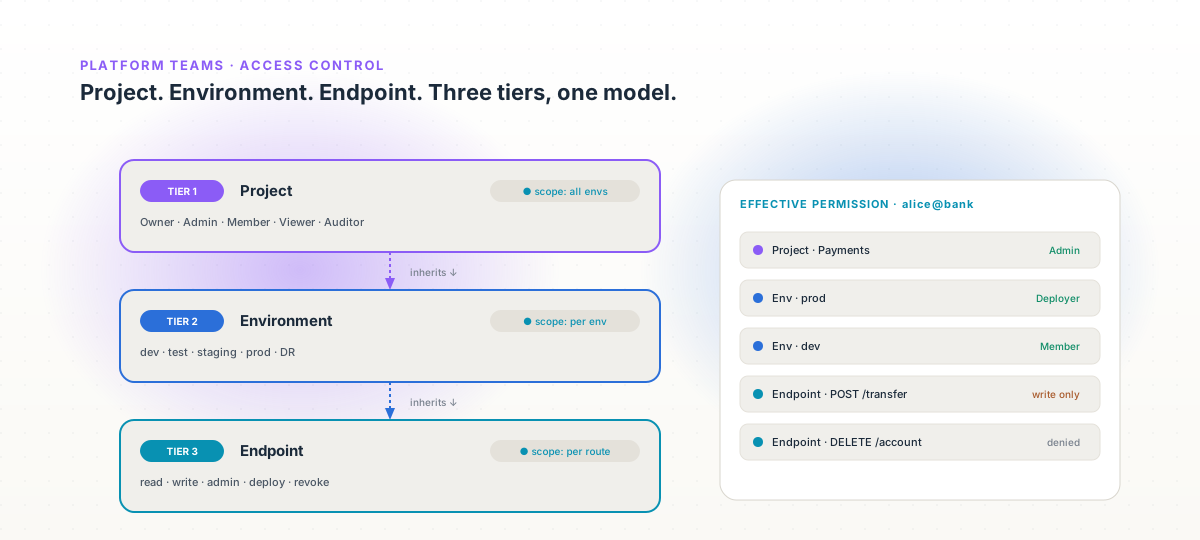
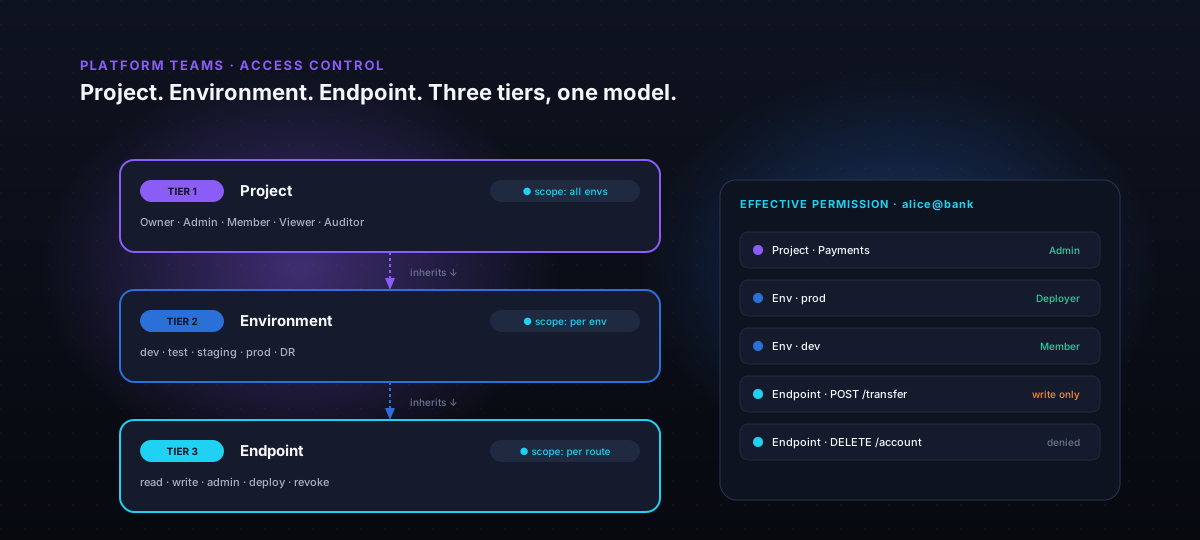
Either everyone is an admin (and the auditor leaves angry), or every change becomes a ticket (and engineers leave angry). Apinizer's three-tier model gives platform teams a way out: Platform owns governance, Projects own delivery, Environments own operations. Each tier has explicit scopes; nobody escalates by accident.
Capabilities
Owns the global policies, identity sources, encryption keys, and audit destinations. The smallest group with the largest blast radius — and the strictest controls.
Each business domain — payments, claims, inventory — gets its own project. Owners design, ship, deprecate within their boundary. They cannot see other projects' secrets.
Dev, test, staging, DR, prod — each is its own access scope. Promotion requires explicit grants; nobody pushes to prod by hitting the wrong dropdown.
Roles map from your existing AD / LDAP / OIDC groups. Onboarding is a group membership change; offboarding is automatic.
Every grant, change, deploy, and view captured at the persistence layer. The trail is queryable by user, project, environment, and time window.
API keys, tokens, and credentials live as encrypted fields — decrypted only at runtime, never visible in lists or exports.
Use cases
Each unit ships APIs within their own project. Platform stays out of the daily flow; auditors see who did what without paging anyone.
Citizen project lives in one tier; backoffice project in another. Operators in one cannot read secrets in the other; audit confirms quarterly.
Platform tier holds 4 people. Project tiers hold 27 owners. Environment promotions need a different person than the author — enforced by the gateway, not by policy memos.
4 / 27 / 110 split
AD groups drive every grant. New hires get access on day one; leavers lose it on day zero. No spreadsheets, no Wiki pages tracking who has what.
Three project owners; three audit lanes. When a partner asks for a change, the right team has the right keys — and only those keys.
Author and approver are different humans in different AD groups. The gateway enforces the split; the auditor's quarterly export is a one-liner.
Each clinic project sees its own APIs and nobody else's. Platform tier holds patient-data classifications; clinics cannot remove them.
Promotion to prod requires a referenced ticket in ITSM. The gateway stamps the audit record with the ticket ID — auditors stop asking for spreadsheets.
How it works
Federate from AD / LDAP / OIDC. Roles map to existing groups — no parallel user store.
Each business domain gets its own project with its own secrets, variables, and owners.
Dev, test, staging, prod, DR — explicit grants per environment. Promotion is a permission, not a habit.
Every grant, change, deploy, and view writes immutable audit. Export by query, not by request.
Recommended products
OAuth2, OIDC, JWT, LDAP, AD, SAML — federate identity once, reuse it across every tier.
Open the Identity pageThe runtime that enforces tier scopes on every request and every config change.
Open the Gateway pagePer-user, per-project, per-environment views. See what your tiers actually do.
Open the Analytics pageSame three tiers for LLM and agent traffic. The AI plane inherits the access model.
Open the AI Gateway pageResources
How Platform, Project, and Environment scopes compose — and what auditors look for.
OAuth2, OIDC, JWT, LDAP, AD, SAML — federated identity for every tier.
Audit enforced at the framework boundary — bypass is rejected, not policed.
How three-tier maps to BDDK, KVKK, GDPR, ISO 27001 segregation-of-duties controls.
Where the audit plane and identity surface live in the topology.
Banks, ministries, defense, telecom — teams that already run three-tier in production.
Permissions that match how teams actually work
A 30-minute walkthrough — Platform, Project, Environment, and the audit trail behind them.