Audit at the persistence layer
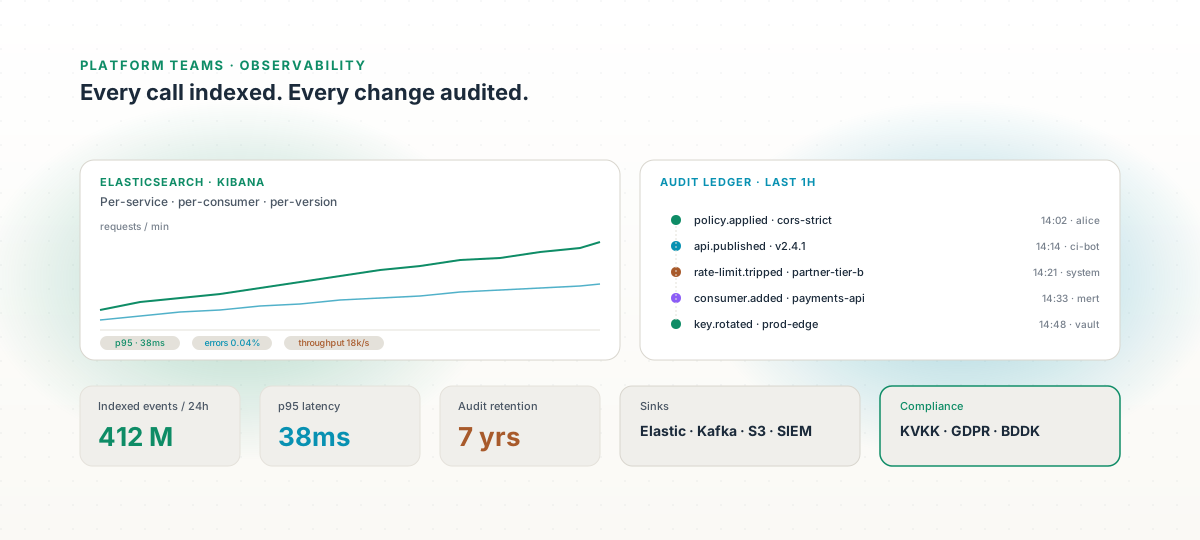
Enforced at the framework boundary — bypass is rejected, not policed by convention. Who, what, when, from where; immutable, exportable, regulator-shaped.
Platform teams · Telemetry
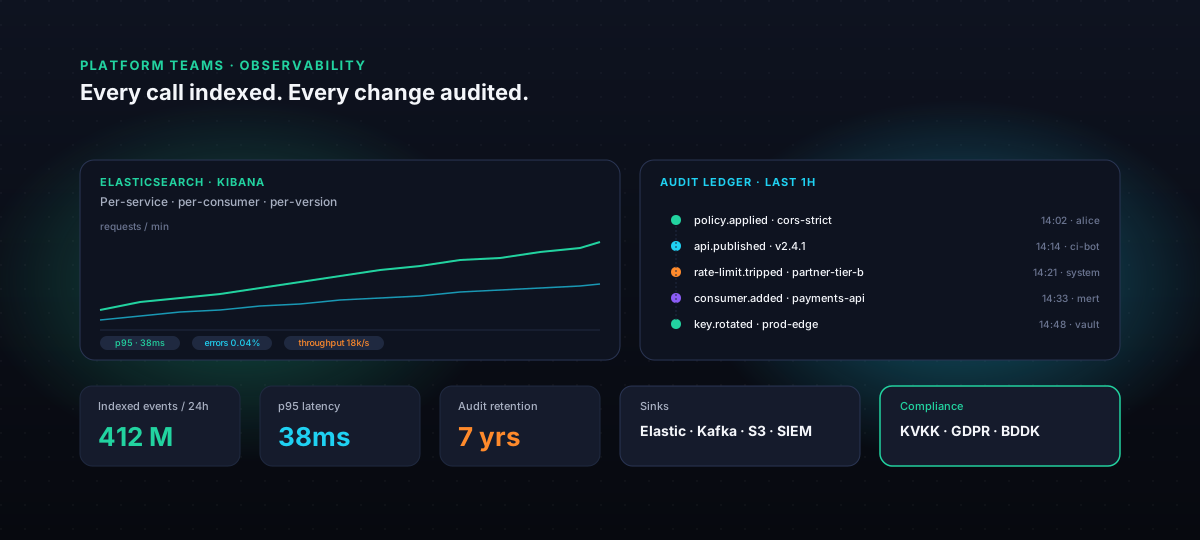
Every request, every change, every grant — captured at the framework boundary, indexed in Elasticsearch, queryable by humans and exportable to regulators.
The problem
Ops gets a dashboard. Compliance gets a spreadsheet. The two don't reconcile, and when a regulator asks 'what happened on Wednesday at 14:32', someone joins three tools and prays. Apinizer treats both as the same plane: the audit ledger is queryable telemetry, and the telemetry is auditor-grade.
Capabilities
Enforced at the framework boundary — bypass is rejected, not policed by convention. Who, what, when, from where; immutable, exportable, regulator-shaped.
Every request indexed in real time — request, response, latency, headers (with PII masked), and the policy chain that handled it.
EMA + Bollinger bands on traffic shape, latency, and error rate. Set sensitivity once; the gateway opens alarms only when the curve actually breaks.
Four grades, nine action types, fifteen-plus connectors. P1 reaches on-call; P3 lands in the daily digest.
Join request logs to audit events to policy changes — for any window, any consumer, any endpoint. A single query answers the regulator.
Platform sees everything. Project owners see their domain. Environment operators see the lane they run. Same data, different scopes.
Use cases
What used to be a three-week project becomes a saved query. Every grant, change, and request joins on one timeline.
3 weeks → 1 query
Traffic shape on a low-volume endpoint drifted 4× in three hours. Anomaly fired in 12 minutes; SOC stopped the integration before the next batch.
12 min to detection
Audit is queryable — not a forensic build-out. The regulator's request closes the same business day.
Support ticket → consumer → audit chain → root cause. Mean time to explain drops from days to minutes.
Bollinger bands on pricing API response distribution. A bad model push moved the curve; alarm fired before customers noticed.
8 min to alarm
Operators see only their substation; auditors see the union. The annual compliance file is generated automatically on December 31.
Personal-data flows joined to consent records, retention windows, and access logs. Article 30 is a saved view, not a yearly project.
Anomaly + severity-aware fan-out: P1 reached on-call in 90 seconds; root cause posted to the SOC in 7 minutes.
How it works
Every request, change, grant, and view is captured at the framework boundary — no opt-in, no convention.
Telemetry and audit land in Elasticsearch in real time. PII masked on the way in; raw bodies optional and scoped.
Platform, project, environment views; saved searches; ad-hoc joins. Regulator-shaped exports on a schedule.
Anomaly + severity policy fan out across nine action types and fifteen-plus connectors. P1 to on-call, P3 to digest.
Recommended products
Elasticsearch-backed real-time analytics for every request and policy decision.
Open the Analytics pageUptime probes, anomaly detection, and severity-aware action chains in one module.
Open the Monitoring pageThe runtime where audit is enforced at the persistence layer, not bolted on later.
Open the Gateway pageSame observability and audit for LLM, MCP, and agent traffic.
Open the AI Gateway pageResources
How telemetry and audit share the same plane — and what regulators look for.
Real-time per-endpoint, per-consumer, per-region telemetry on Elasticsearch.
Uptime, anomaly detection, severity-aware alarms — one module.
Mapping to BDDK, KVKK, GDPR, ISO 27001 evidence requirements.
Changes flow through Git; audit captures the apply, the actor, and the diff.
Where audit and telemetry live in the data plane.
Telemetry meets evidence
A 30-minute walkthrough — capture, index, query, alarm — on a Kubernetes of your choice.