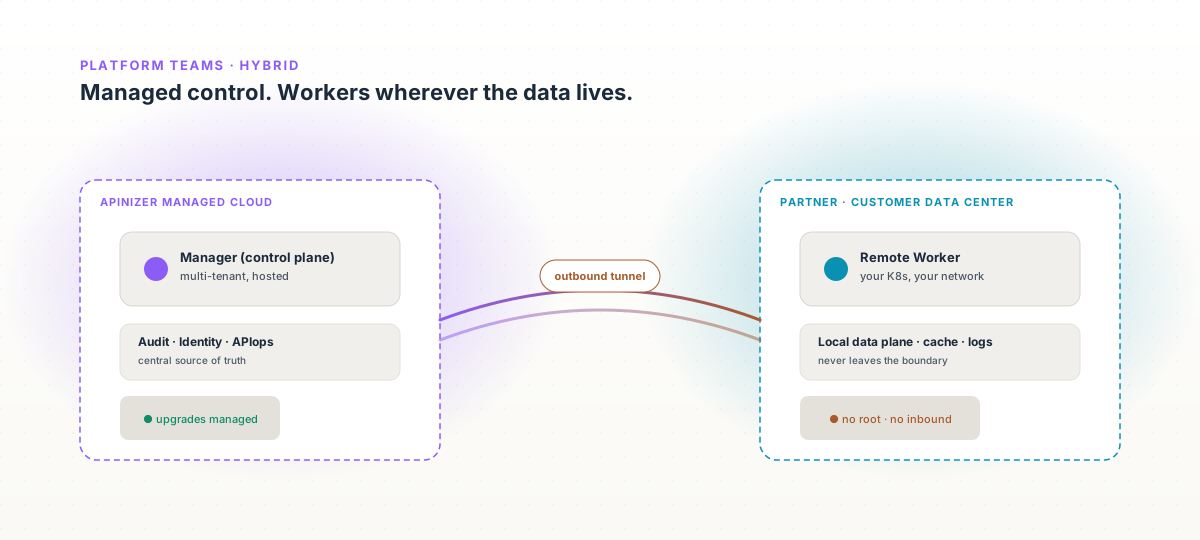
Managed control plane
Run the Manager on your most trusted cluster. It publishes definitions, holds the audit trail, and never sits in the runtime path.
Platform teams · Hybrid
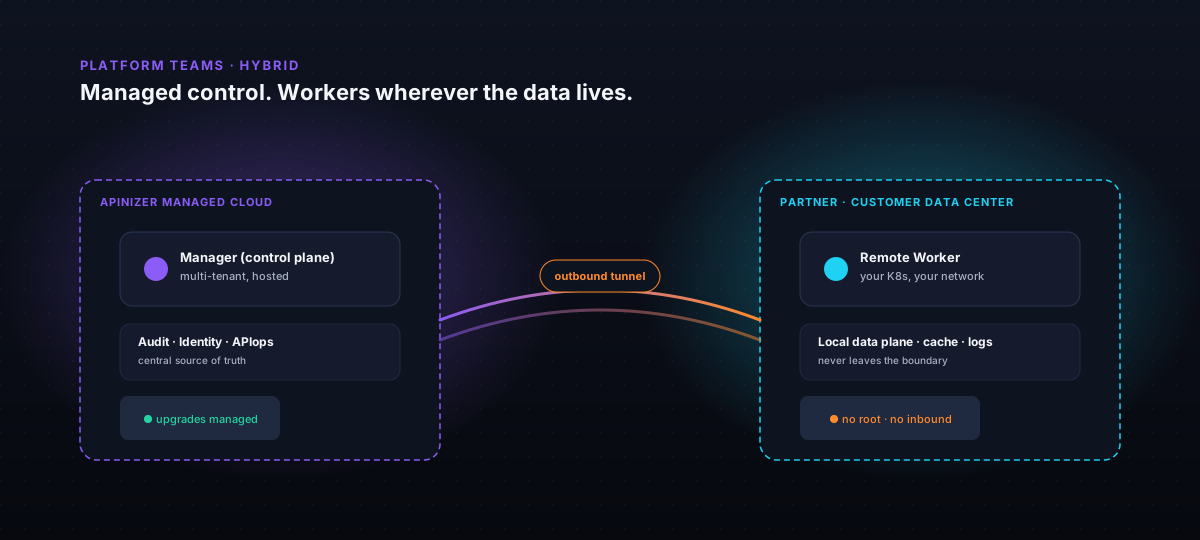
Managed control plane in your central cluster, Workers in regions you might not even own. One source of truth, many runtimes, zero shared root access.
The problem
A partner won't give you a kubeconfig. A regulator demands the data stays in-country. A factory floor goes offline twice a day. Most gateways collapse under any of those — the platform either gives up on the edge or hand-rolls a second installation. Apinizer's hybrid pattern keeps one Manager in charge while Workers run wherever, with no shared credentials and no shared blast radius.
Capabilities
Run the Manager on your most trusted cluster. It publishes definitions, holds the audit trail, and never sits in the runtime path.
Push Workers to partner data centers, edge sites, or sovereign zones. The Manager pulls health and pushes definitions over a secure outbound channel.
Partners never get keys to your cluster, and you never get keys to theirs. The Worker authenticates with a short-lived credential issued by the Manager.
When the link to the Manager drops, the Worker keeps serving on the last published definition. Reconciliation resumes when the WAN comes back.
Traffic stays in the country the Worker runs in. Logs, metrics, and policy can be configured to never leave the local cluster.
Operators that cannot reach the central Manager pull a signed bundle on a schedule. The audit ledger reconciles when connectivity is restored.
Use cases
Central Manager in Istanbul publishes to Worker clusters at four regional sites. Each Worker handles branch traffic locally; nothing leaves the country.
Suppliers run Apinizer Workers locally for parts integration. The OEM owns the definitions; suppliers own their operating environment.
9 suppliers, 0 shared keys
Definitions published from a national sovereign cloud. Workers in legacy on-prem clusters reconcile inbound; no public endpoint exposed.
Patient data never leaves the hospital. The Manager in the regional health authority publishes policy and receives sanitized telemetry.
0 PHI egress
Air-gap mode: a signed bundle ships nightly. The operator network never establishes outbound to the Manager; audit reconciles weekly.
Partner POPs run Workers for B2B traffic. The Manager publishes to all of them in parallel; rollout time goes from weeks to minutes.
230 edges
When the WAN drops at shift change, the local Worker keeps serving MES APIs. Reconciliation picks up when the link returns; the line never stops.
Partner data centers run Workers under their own ops. The ministry's Manager publishes policy and pulls health; partners never see ministry secrets.
How it works
Pick the cluster you trust most — central, regional, sovereign. The Manager never carries production traffic.
Install Workers in partner, edge, or air-gapped environments. They register with the Manager using a short-lived credential.
Apply once on the Manager. Each Worker reconciles on its own schedule — minutes for online, hours/days for air-gap.
Health, lag, and audit roll up to the Manager. Partners and operators keep ops local; you keep policy central.
Recommended products
The Worker pattern designed for managed + remote: short-lived credentials, inbound reconcile, local survival.
Open the Gateway pageSame hybrid pattern for LLM and agent traffic — keep model calls in-region, govern from the center.
Open the AI Gateway pageProbes that run inside each remote Worker; alarms that escalate when reconcile lag crosses a threshold.
Open the Monitoring pagePer-Worker traffic and health — see what each remote site is doing without ssh'ing into it.
Open the Analytics pageResources
How the Manager pushes policy outbound while Workers reconcile inbound — even from air-gapped networks.
Control plane / data plane separation with no shared root between sites.
Project / environment / endpoint scopes apply identically across managed and remote Workers.
Per-Worker, per-region, per-environment visibility.
Topology patterns when you do own every cluster in the picture.
The Worker that runs anywhere Kubernetes runs.
Hybrid, by design
A 30-minute walkthrough — managed control plane, remote Workers, air-gap mode — on a Kubernetes of your choice.