Audit at the persistence layer
Every change — config, secret, grant, deploy, view — captured immutably. Bypass is rejected at the framework, not by code review.
Executives · Compliance
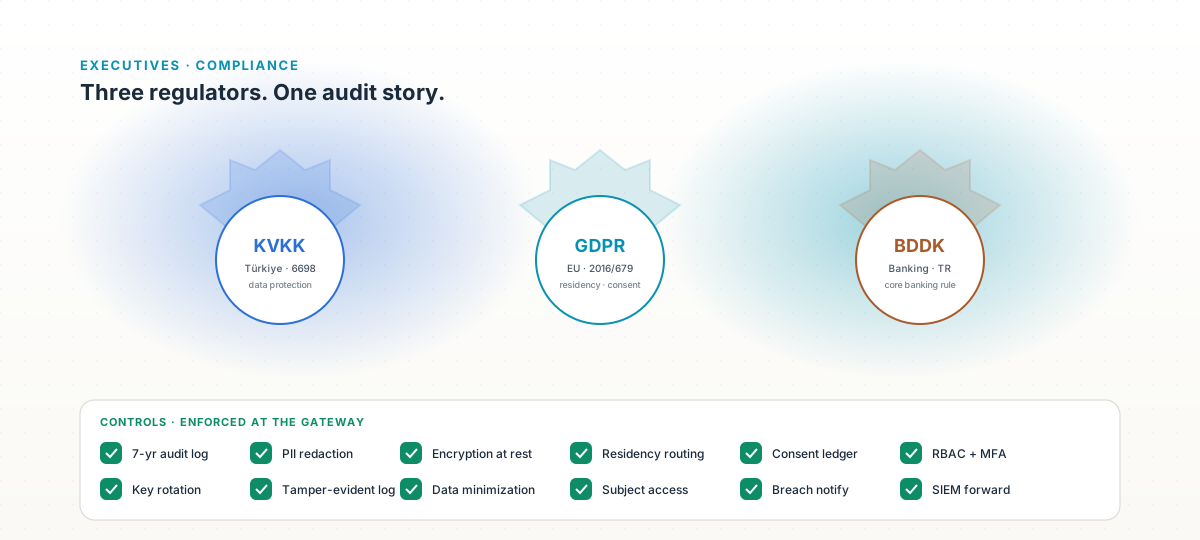
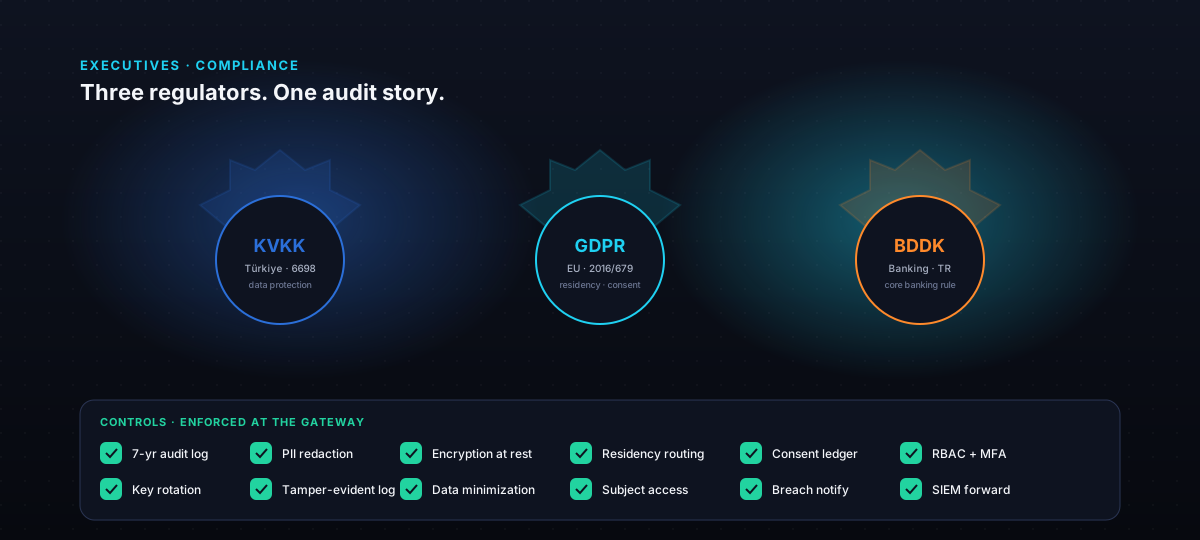
Audit at the framework boundary, encryption at the persistence layer, three-tier access at the runtime — the regulator's checklist already lives inside the platform.
The problem
Most platforms treat audit, encryption, and access as opt-in middleware. Compliance teams discover the gap in October, with November to fix it. Apinizer treats those controls as constitutional: they're enforced at the framework boundary, not by convention. The evidence packet auditors ask for ships out of the platform as a query, not a project.
Capabilities
Every change — config, secret, grant, deploy, view — captured immutably. Bypass is rejected at the framework, not by code review.
Tokens, keys, and credentials encrypted before persistence; decrypted only at runtime. They never appear in lists, exports, or backups.
Article 4(5) asks for data that can be re-attributed under controlled conditions — not data destroyed on the way past. Masked identifiers are replaced with a stable placeholder that authorized roles can restore inside the response or read back through a separate unmask API. The restore is deny-by-default, and both the decision and its scope land in the audit record. Synthetic replacements are generated independently rather than derived from the original, which is what HIPAA and GDPR require of a non-derived value.
Data minimization becomes a setting instead of a project. Three profiles decide how much of an AI exchange is ever written down — the full record, counters and decisions without the bodies, or nothing persisted at all. Set the installation default, override it per API proxy, and the stricter of the two wins.
Platform, Project, Environment scopes federated to your AD / LDAP / OIDC. Segregation of duties enforced by the runtime, not by memo.
Personal-data flows joined to consent, retention, and access logs. GDPR Article 30 / KVKK envanteri queries return in seconds.
BDDK, PSD2, SAMA, ACPR, AYM — every regulator's emphasis maps to a control already in the platform. We share the mapping packet.
Quarterly evidence packs generated automatically. Auditor requests close the same business day instead of the same quarter.
Use cases
What used to be a three-week reconciliation project becomes a query and an export. Auditors stop asking, 'who has access to X'.
3 weeks → 1 day
Article 30 record of processing joins personal-data flows to consent, retention, and access logs. The DPO ships a packet by 17:00.
Audit, encryption, and segregation-of-duties mapped to SAMA paragraphs in the evidence packet. The regulator's review closes early.
Every PHI access logged; every retention window enforced. The HDS auditor signs off after one visit instead of three.
CAD (Codice dell'Amministrazione Digitale) controls map one-to-one to platform features. Audit posture documented in one page.
Audit retention, segregation of duties, and encryption-at-rest mapped. The ENS audit closes with no findings.
Incident reporting, supply-chain audit, and access controls — all already covered by Apinizer's existing model.
Local AYM controls overlap heavily with KVKK. One platform, two regulators, one evidence pack.
Recommended products
Audit, encryption, and three-tier access enforced at the framework boundary — not by convention.
Open the Gateway pageFederate to your sovereign identity store; never carry a vendor user database.
Open the Identity pageCompliance evidence as queries — Article 30, segregation-of-duties, retention reports.
Open the Analytics pageSame audit and compliance model for the AI plane — LLM, MCP, agent traffic.
Open the AI Gateway pageResources
How Apinizer maps to KVKK, GDPR, BDDK, PSD2, PCI-DSS, ISO 27001 controls.
BDDK + PSD2 + PCI-DSS as a single posture.
Sovereign hosting, audit, and access for ministries and agencies.
Segregation of duties enforced by the runtime.
Regulated customers running Apinizer in production.
Where audit, encryption, and identity sit in the topology.
Compliance built in
A 30-minute walkthrough — audit, encryption, three-tier access, and the evidence query — on a Kubernetes of your choice.