Semantic caching
Equivalent prompts hit cache, not the model. 'Summarize this contract' on the same contract serves from cache; the underlying model is never called twice for the same answer.
Executives · AI economics
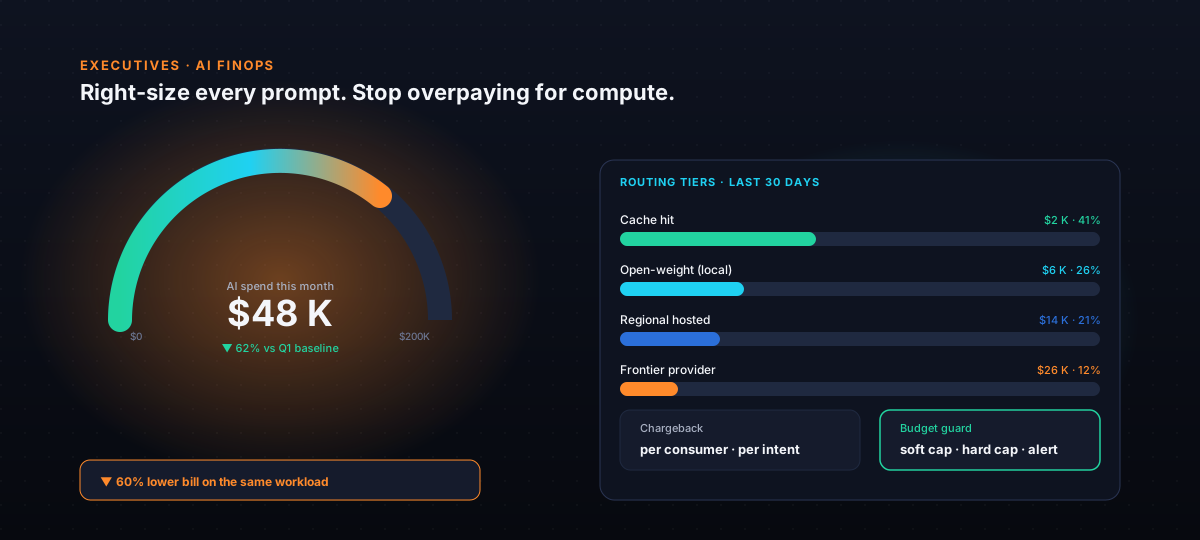
Apinizer's AI Gateway routes calls to the cheapest model that satisfies the SLA, caches answers semantically, enforces per-team budgets, and attributes every token to the consumer that asked for it.
The problem
Engineers point a service at a frontier model. Token meters spin. The bill is fine in week one, alarming in month one, and a board-level conversation by quarter end. By then attribution is impossible — twelve teams share one API key, and nobody knows which prompt cost what. Apinizer puts every AI call through a gateway that meters, attributes, caches, and routes — before the spend happens.
spend cut
semantic cache + smart routing
calls attributed
per team / project / consumer
budget alarms
Capabilities
Equivalent prompts hit cache, not the model. 'Summarize this contract' on the same contract serves from cache; the underlying model is never called twice for the same answer.
Route simple intents to small / cheap models, complex intents to frontier models. The gateway picks per call, not per service.
Hard caps and soft alarms per project, team, or consumer. When a budget is reached, the gateway throttles or fails over — no surprise.
Every token tagged with consumer, project, and prompt fingerprint. Cost shows up in the dashboard the day it was spent.
Prompt tokens, completion tokens, cache hits, fallbacks — broken out by model, endpoint, and consumer. Finance gets the same view as engineering.
Power users get more; weekend batch jobs get less. Quotas are a policy you write once and the gateway enforces on every call.
Use cases
Semantic cache absorbs 71% of duplicate prompts. Routing sends short intents to a smaller model; only escalations reach the frontier provider.
−58% monthly
Per-team budgets at €X. Alarms fire at 80%; throttle at 100%. The CFO sees burn rates instead of surprise invoices.
Every token is tagged with the squad that asked for it. Cost showbacks appear in the existing FinOps dashboard.
EU-hosted model handles 92% of summaries; frontier provider used only for adversarial or multi-language cases. Latency improves and spend drops together.
−42% spend, +18% latency
Time-of-day policy: night batch on the cheap tier, daytime live traffic on the premium tier. Cost-to-serve drops without an SLA change.
Department quotas published. Departments see real-time burn; over-runs require a written request, not a surprise email.
Routing prefers the national Arabic model first; falls over to international providers only on miss. Sovereignty and cost align.
Semantic cache deduplicates near-identical SKU prompts. Routing handles long-form on a frontier model; short-form on a 7B open model.
−64% spend
Recommended products
Token-aware routing, semantic caching, per-team budgets, prompt firewalls — the AI cost lane.
Open the AI Gateway pagePer-team, per-consumer, per-model breakdowns — finance and engineering on the same view.
Open the Analytics pageDistributed cache that backs the semantic layer with deterministic invalidation.
Open the Cache pageAlarms on budget burn rates, anomaly detection on prompt spend, severity-aware action chains.
Open the Monitoring pageResources
Routing, caching, attribution, quotas — how the AI Gateway controls spend.
The AI lane — every model call through one governed plane.
Distributed cache backing semantic responses.
Per-team, per-consumer cost dashboards.
The engineering view of the same problem.
Where the AI lane sits relative to API and identity surfaces.
Explore more
Make AI spend a line you control
A 30-minute walkthrough — routing, caching, budgets, attribution — on a Kubernetes of your choice.